
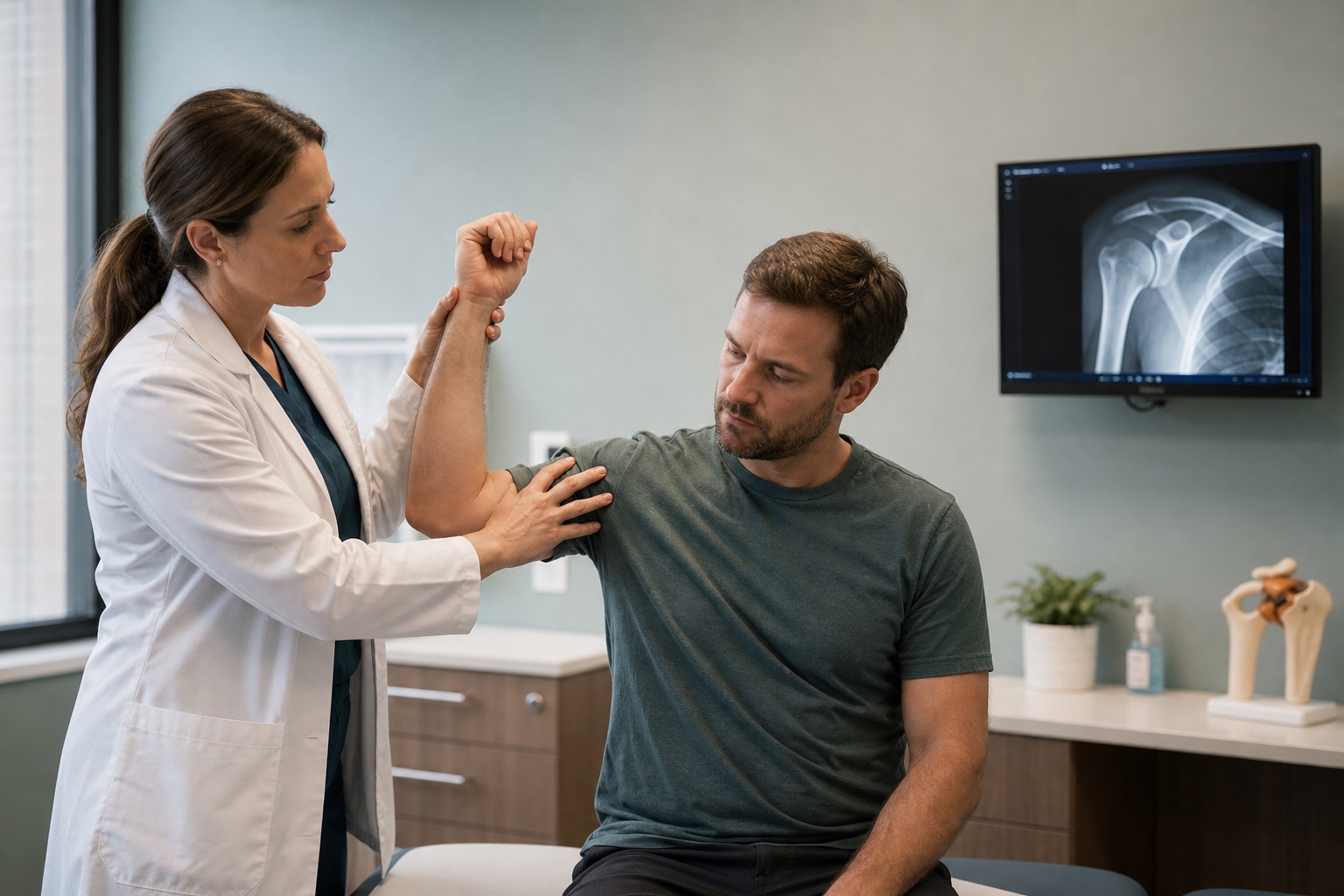
A normal X-ray does not mean nothing is wrong
A patient may leave urgent care with reassuring news: no fracture appears on the X-ray. Yet the shoulder still hurts, the knee feels unstable, or the neck remains stiff. That can be confusing when someone assumes a normal X-ray means there is no injury.
X-rays answer important bone and alignment questions, but they do not show every tissue equally well. Muscles, tendons, ligaments, cartilage, and other soft tissues may be injured even when no broken bone appears.
What counts as a soft-tissue injury?
A sprain involves a ligament, which connects bone to bone. A strain involves muscle or tendon, which connects muscle to bone. Contusions are bruises caused by direct impact. Injuries may also affect cartilage, the joint capsule, the rotator cuff, or the knee meniscus.
Severity ranges from overstretching and microscopic fiber damage to partial or complete tearing. Pain on day one does not always predict the final diagnosis, and swelling or stiffness may evolve over several days.
Why different imaging may be considered
X-rays are useful for many fractures, dislocations, and alignment problems but provide limited soft-tissue detail. MRI can show many tendons, ligaments, cartilage structures, muscles, and bone bruises. Ultrasound can evaluate certain tendons, muscles, fluid collections, and movement in real time. CT provides detailed views of complex bone injury.
Some subtle fractures can also be difficult to see initially. When examination findings remain concerning, a clinician may recommend repeat imaging or another modality. The choice should follow the suspected injury—not a one-size-fits-all protocol.
The examination often leads the diagnosis
An orthopedic evaluation connects symptoms with function. The clinician may compare both sides, observe swelling and bruising, assess active and passive motion, test strength and stability, and identify areas of tenderness.
Functional details matter. Can you raise the arm, bear weight, turn the neck, grip an object, or climb stairs? Does the joint lock, catch, buckle, or feel unstable? Those observations help determine whether more imaging or specialist care is appropriate.
Measure recovery through function
Soft-tissue healing varies with the tissue, severity, age, prior conditions, activity demands, and rehabilitation. Treatment may include temporary activity modification, medication, bracing, rehabilitation, injections in selected cases, or surgical consultation for significant structural damage.
Document sleep, walking tolerance, lifting ability, missed work, range of motion, and activities you cannot perform normally—not only a pain score. Functional change helps the clinician judge progress and decide whether the diagnosis needs another look.
Common questions
Frequently asked questions
Can you have a soft-tissue injury with a normal X-ray?+
Yes. X-rays show bones well but provide limited information about muscles, tendons, ligaments, and cartilage.
How long do soft-tissue injuries take to heal?+
Recovery varies. Some improve over days or weeks, while significant tendon or ligament injuries may take longer and require structured rehabilitation or specialist care.