
Neurological symptoms can be subtle
A neurological injury does not always announce itself with loss of consciousness. After a collision, patients may notice headache, dizziness, light or noise sensitivity, blurred vision, balance changes, slowed thinking, poor concentration, memory difficulty, sleep changes, numbness, tingling, or weakness. Some symptoms begin immediately; others become clearer over the next several hours or days.
These symptoms can overlap with pain, medication effects, sleep disruption, emotional stress, and cervical injury. A neurological evaluation helps organize the pattern rather than treating each symptom as an isolated complaint.
Reasons to request a neurological evaluation
Consider asking about neurology when symptoms persist, worsen, interfere with work or daily function, or include cognitive, balance, sensory, or motor changes. A neurologist reviews the mechanism of injury, symptom timeline, prior neurological history, emergency records, medications, and the findings of a focused examination.
The goal is not to order every available test. It is to determine whether symptoms suggest concussion, peripheral nerve injury, cervical or lumbar nerve-root involvement, seizure risk, migraine, vestibular dysfunction, or another condition that requires a specific plan.
- Persistent or worsening headaches
- Dizziness, imbalance, or coordination problems
- Memory, attention, processing-speed, or speech changes
- Numbness, tingling, burning, or weakness
- Vision changes or sensitivity to light and sound
- A seizure, loss of consciousness, or unusual episode
Emergency danger signs come first
Call 911 or seek emergency care for a headache that worsens and does not go away, repeated vomiting, seizure, slurred speech, unusual behavior, increasing confusion, unequal pupils, new weakness or numbness, loss of consciousness, or inability to wake. Outpatient neurology should never delay emergency assessment.
After emergency threats are addressed, follow-up may still be appropriate when symptoms continue. Bring discharge paperwork and imaging information so the neurologist can place the current symptoms in context.
What EEG, qEEG, brain mapping, and MRI can—and cannot—do
EEG records electrical brain activity and may be used when seizure or abnormal electrical activity is a clinical concern. Quantitative EEG applies mathematical analysis to EEG data, while brain mapping displays patterns for interpretation. These studies do not replace the history, examination, or emergency imaging and should not be presented as stand-alone proof of a traumatic brain injury.
MRI evaluates brain and spine structure. Diffusion tensor imaging, or DTI, is an MRI-based technique that may be considered in selected situations. The usefulness of any study depends on the clinical question, timing, image quality, interpretation, and how the result affects care.
Statewide access through telehealth and mobile testing
History review, symptom follow-up, medication discussion, and selected examination components may be completed by telehealth. An in-clinic visit may be recommended when hands-on strength, reflex, gait, balance, or other detailed testing is needed.
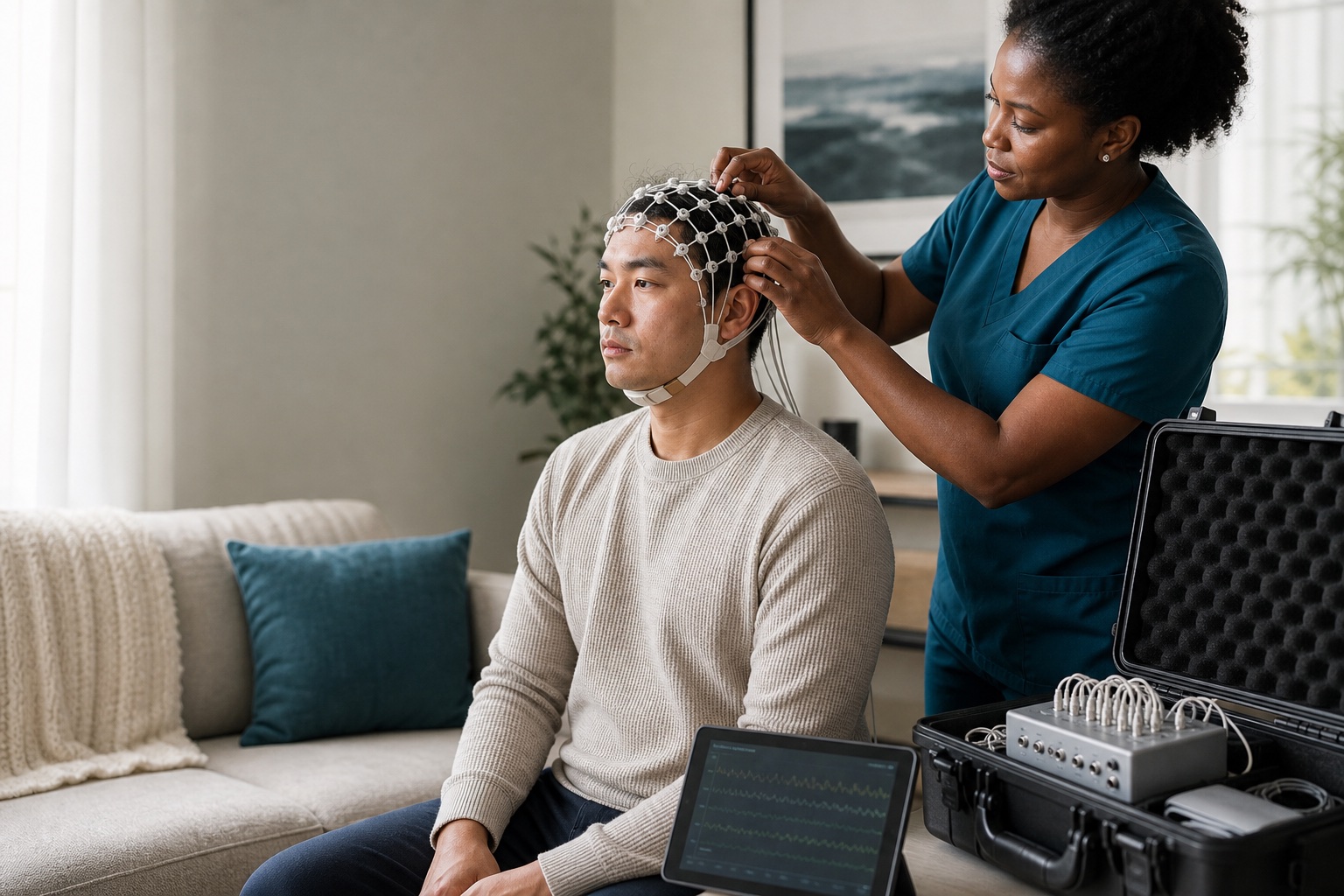
SpineLUX offers telehealth or in-clinic neurological consultation. Mobile EEG, qEEG, and brain mapping are available across Texas when clinically appropriate, helping patients outside a major city access the diagnostic pathway without assuming that every service requires long-distance travel.
Common questions
Frequently asked questions
Do I need to lose consciousness to have a concussion?+
No. A concussion can occur without loss of consciousness. Symptoms may affect physical comfort, thinking, mood, behavior, and sleep.
Can a neurology visit be completed by telehealth?+
Many history and follow-up components can be completed by telehealth. The neurologist may recommend an in-person visit when hands-on examination is needed.
Are qEEG and brain mapping available at home?+
SpineLUX offers mobile EEG, qEEG, and brain mapping across Texas when ordered for an appropriate clinical question.