
A dashboard injury happens when your knee hits the dash or the seat in front of you during a crash. It can bruise the kneecap, crack bone, or tear the ligament behind the shin. Swelling, trouble bearing weight, or a knee that gives way needs an orthopedic exam soon, even if X-rays were normal.
What is a dashboard knee injury?
When a car stops suddenly, your body keeps moving forward. If you're in the front seat, your knees can slam into the dashboard or the lower panel under it. Back seat passengers can hit the seat in front of them. The force lands on the front of a bent knee and drives the shin bone backward.
That specific motion is why doctors pay close attention to the posterior cruciate ligament, or PCL. It's the strong ligament that stops the shin from sliding back under the thigh bone. A direct blow to the front of the shin is one of the most common ways it tears.
Other structures can be hurt too. The kneecap can bruise or fracture. Cartilage under the kneecap can be damaged. The meniscus, the cushion inside the joint, can tear if the knee twists at the same time. In bigger crashes, the force can travel up the leg and injure the hip.
What symptoms should I watch for?
Some dashboard injuries are obvious. Others start quietly and become clear over a few days once swelling builds and you try to walk normally.
Get the knee checked if you notice:
- Swelling that shows up within hours or keeps growing over a day or two
- Pain on the front of the knee when kneeling or climbing stairs
- A feeling that the knee is loose or shifts when you walk downhill or stop suddenly
- Clicking, catching, or the knee locking in place
- Trouble straightening the knee all the way
- Bruising on the front of the shin just below the kneecap
That last one is easy to dismiss. A bruise just below the knee is a clue the shin took a direct hit, which is the classic setup for a PCL injury.
Go to an emergency department right away if the knee looks deformed, you can't put any weight on the leg, or your foot turns cold, pale or numb. Those can be signs of a fracture, dislocation or blood vessel injury.
Why can a knee ligament tear be missed at first?
PCL tears are often less dramatic than ACL tears. Many people can still walk on the leg. The pain may be mild compared to a sore neck or back after the same crash, so it gets overlooked.
X-rays also don't show ligaments. A normal X-ray rules out many fractures, but it can't see a torn ligament, a meniscus tear, or a bone bruise. If your exam suggests one of those, an MRI is usually the next step.
An untreated PCL tear doesn't always cause trouble right away. Over months, though, the knee can feel unstable and wear unevenly, especially under the kneecap and on the inner side of the joint. Getting an accurate diagnosis early gives you more options.
What happens at an orthopedic exam for knee pain?
An orthopedic specialist starts with what happened in the crash and how your symptoms have changed since. Then they examine both knees and compare them.
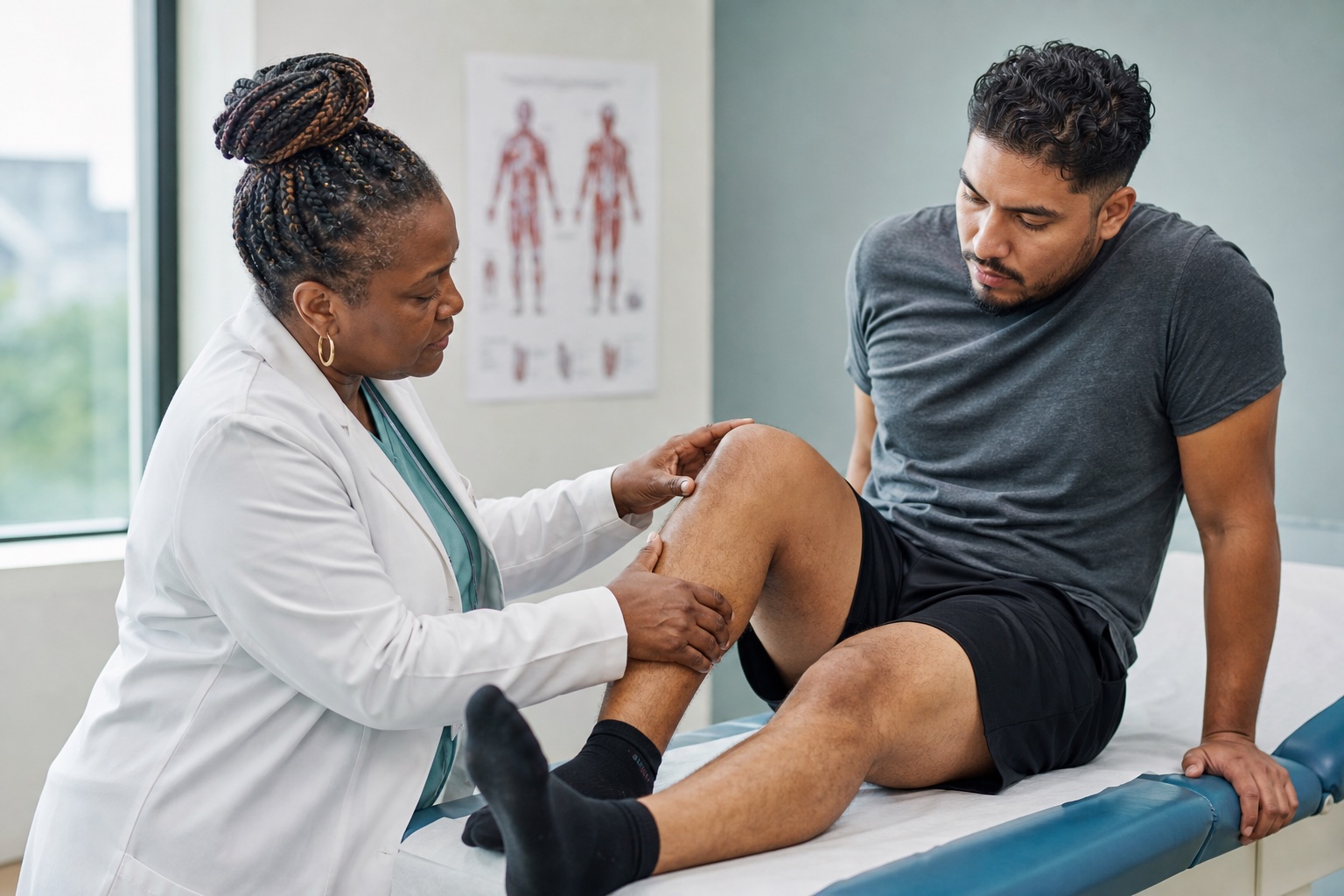
For a suspected PCL injury, a common test is the posterior drawer. With your knee bent, the doctor gently pushes the shin backward and feels how far it moves. They'll also look at whether the shin sags when your legs are held up, check your kneecap, test the other ligaments, and look for swelling inside the joint.
Imaging follows the exam. X-rays look for fractures. MRI shows ligaments, cartilage, meniscus and bone bruising. Your doctor orders what fits your findings, not a standard package.
How is a dashboard knee injury treated?
Treatment depends on what's injured and how badly.
Many PCL tears that are partial, and some complete tears that happen alone, are treated without surgery. That usually means a short period of protection, sometimes with a brace that supports the back of the shin, followed by physical therapy focused on the quadriceps. Strong quads help hold the shin in place.
Kneecap bruises and cartilage irritation also usually respond to rest from aggravating activity, therapy and time.
Surgery comes into the conversation when several ligaments are torn, a fracture needs fixing, the meniscus is torn in a way that catches or locks, or the knee stays unstable after a full course of rehab.
Recovery time varies a lot. A bone bruise may settle in weeks. A ligament injury can take several months of steady work.
Can knee pain after a crash affect my back or hip?
Yes. When one knee hurts, people change how they walk, often without noticing. That shift can load the other knee, the hip and the lower back differently. If back or hip pain shows up weeks after the knee injury, mention it. It may be related, or it may be a separate injury from the crash that needs its own evaluation.
How do I get care for a knee injury after an accident in Texas?
SpineLUX orthopedics evaluates bone, joint, muscle, tendon and ligament injuries after accidents, and coordinates imaging when your exam calls for it. Clinics serve Irving, Houston, San Antonio, Live Oak, McAllen and El Paso, with bilingual intake in English and Spanish.
Questions about payment? Call 972-920-9111 and our team will walk you through it. All services are offered in Spanish.
Call 972-920-9111 to start. The Irving clinic is at 100 E Royal Ln, Suite 125.
This article is general information, not medical advice. Treatment depends on an individual clinical evaluation, and results vary.
Common questions
What else do patients ask?
My X-ray was normal. Do I still need an MRI?+
Maybe. X-rays don't show ligaments, cartilage or meniscus. If your exam points to one of those, your doctor may order an MRI.
Can I walk on a torn PCL?+
Often, yes. That's one reason PCL tears are missed. Being able to walk doesn't mean the knee is uninjured.
How long should I wait before seeing a doctor?+
Don't wait for it to get worse. Swelling, instability or pain that isn't improving after a few days should be examined.
Should I use a knee brace from the store?+
A brace may feel supportive, but the wrong kind can hide a problem or slow recovery. Get examined first, then use the brace your doctor recommends.
Will I need surgery?+
Most isolated PCL tears and kneecap bruises are treated without surgery. Your surgeon decides based on your exam and imaging.