
Why Class IV laser therapy is drawing attention in personal injury care
After a car crash or another injury, pain can make it difficult to sleep, work, drive, exercise, and participate fully in rehabilitation. Class IV laser therapy—also called high-intensity laser therapy or high-power laser therapy—gives clinicians a noninvasive treatment option that can be directed to a specific painful region as part of a broader care plan.
Patients often value a treatment that does not involve an incision or injection. Attorneys and case managers value a service that can be scheduled within a coordinated medical pathway and documented alongside the patient’s examinations, imaging, specialist recommendations, functional goals, and response to care. At SpineLUX Pain & Ortho, laser therapy is integrated with personal injury care rather than treated as an isolated add-on.
What high-intensity laser therapy does
High-intensity laser therapy delivers concentrated light energy to a clinician-selected treatment area. The interaction of light with tissue is commonly described as photobiomodulation. In laboratory and clinical literature, this process is associated with cellular signaling and biological responses relevant to pain modulation, circulation, inflammation, and tissue recovery.
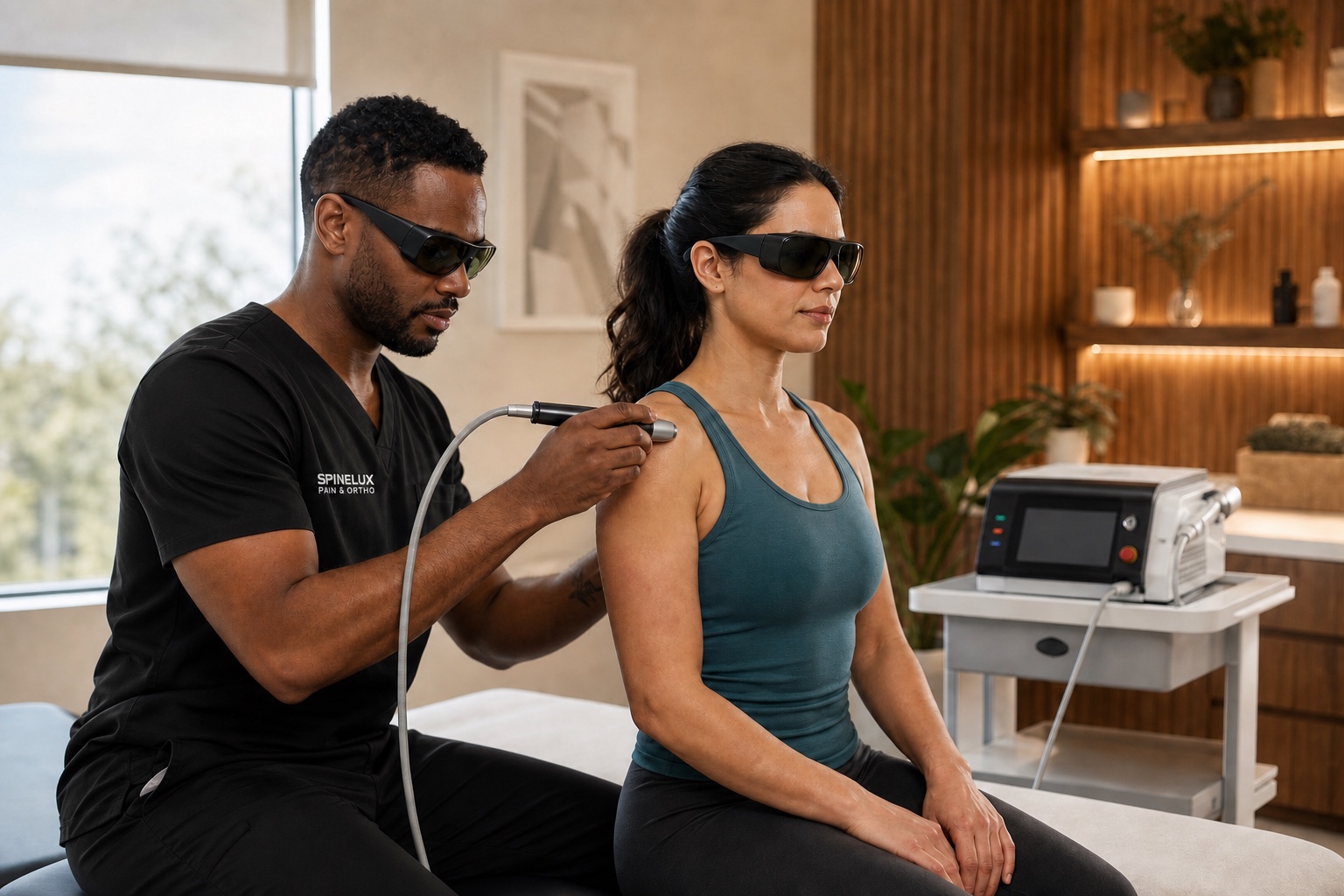
The higher available power of a Class IV system allows a therapeutic dose to be delivered efficiently across a treatment area. The clinician selects the treatment region and settings according to the condition, tissue depth, skin response, and prescribed protocol. The experience is generally described as comfortable warmth while the handpiece is moved over or near the selected area.
What the clinical research shows
A growing body of randomized trials and systematic reviews has evaluated high-intensity laser therapy for musculoskeletal pain. A 2023 systematic review of 48 randomized clinical trials reported improvements in pain and function, with results varying by body region and comparison treatment. Reviews focused on low-back pain, neck pain, knee osteoarthritis, and shoulder conditions have also reported favorable outcomes for pain and selected functional measures.
The most current 2026 network meta-analysis found that high-intensity laser therapy produced greater short-term pain reduction than low-level laser therapy in several comparisons, especially when combined with exercise or other rehabilitation interventions. That finding supports the way SpineLUX approaches injury care: laser therapy can be most useful when it is selected for the right patient and connected to an active, goal-oriented treatment plan.
- Pain relief in studied neck, back, shoulder, knee, and other musculoskeletal conditions
- Improvement in selected measures of function and movement
- A noninvasive option that can complement exercise and rehabilitation
- Targeted treatment that can be adjusted to the body region and clinical plan
How laser therapy may fit after a car accident or other injury
Collision-related symptoms commonly involve the neck, low back, shoulder, hip, knee, wrist, or surrounding soft tissues. A clinician may consider high-power laser therapy when the examination identifies a musculoskeletal pain pattern that is appropriate for this modality. The decision is based on the patient’s symptoms, diagnosis, skin and medical history, functional limitations, and overall plan of care.
Laser therapy can be coordinated with interventional pain management, orthopedics, spine care, imaging, medication management, and rehabilitation. This connected approach matters because reducing pain can help some patients participate more comfortably in the movement, strengthening, and daily activities that support recovery.
The SpineLUX SMART S30A treatment platform
SpineLUX uses the FDA-cleared SMART S30A Class IV laser platform. Manufacturer specifications identify a gallium-aluminum-arsenide diode system with a 980-nanometer wavelength, up to 30 watts of power, continuous-wave and pulsed operating modes, and a 30-millimeter treatment spot. Those features allow the trained provider to select and deliver a protocol for the prescribed treatment region.
FDA clearance is an important regulatory status for a medical device. The FDA explains that a cleared device has completed the applicable premarket review pathway and has been found substantially equivalent to a legally marketed device. At SpineLUX, device selection is paired with clinical evaluation, trained operation, appropriate protocols, and safety procedures.
What patients can expect during a visit
The visit begins with confirmation of the treatment area, symptoms, current health information, and any change since the previous appointment. The provider explains the procedure and positions the patient comfortably. Everyone in the treatment area wears wavelength-appropriate protective eyewear, and the provider maintains control of the applicator throughout the session.
The handpiece is moved according to the prescribed technique while the provider monitors comfort and skin response. Treatment time and frequency vary with the body region, protocol, and individual plan. Afterward, the response is recorded and the patient receives guidance about the next step in the coordinated care plan.
- Noninvasive application with no incision
- Protective eyewear for the patient and treatment staff
- Settings selected for the treatment region and clinical objective
- Ongoing documentation of tolerance, symptoms, and function
- Coordination with other recommended injury-care services
Why coordinated laser therapy can benefit the patient experience
Personal injury patients can become overwhelmed when appointments, diagnostic studies, and treatment recommendations are scattered among unrelated offices. A coordinated system helps the care team understand what has been completed, how the patient responded, and what should happen next.
Within SpineLUX, Class IV laser therapy can be connected with pain management, orthopedics, spine care, neurology and brain injury care, imaging, and mental health counseling. This structure supports timely scheduling, fewer communication gaps, bilingual assistance in English and Spanish, and a clearer medical timeline for the patient.
Why attorneys and case managers are requesting this therapy
Attorneys and case managers are increasingly asking about high-intensity laser therapy because it offers a practical, noninvasive option within conservative injury care. When a qualified clinician finds it appropriate, the treatment can address a defined body region while the patient continues with other parts of the medical plan.
A well-organized record can include the clinical indication, treatment area, dates of service, relevant settings or protocol, tolerance, reported response, functional progress, and coordination with other providers. This information helps authorized parties follow the medical timeline without interfering with the clinician’s independent decisions. SpineLUX also provides a secure referral pathway so legal teams can refer a client without sending protected health information through ordinary email.
- Prompt access to evaluation and treatment when clinically appropriate
- A documented course of care tied to symptoms and functional goals
- Coordination with imaging and specialist consultations
- Consolidated communication across the injury-care pathway
- English- and Spanish-language support for patients
A favorable option within a complete recovery plan
Class IV laser therapy combines advanced technology with a patient-friendly experience. Its value is strongest when the provider identifies a clear clinical objective, applies the treatment safely, measures the patient’s response, and connects it with the rest of the recovery plan.
Texas patients, attorneys, and case managers can contact SpineLUX Pain & Ortho to discuss high-power laser therapy, location availability, and coordinated personal injury care. The intake team can help identify the appropriate starting point and arrange the next clinical step.
Common questions
Frequently asked questions
Is Class IV laser therapy painful?+
The treatment is noninvasive and is commonly experienced as comfortable warmth. The provider monitors comfort and skin response throughout the session.
How many high-power laser therapy sessions will I need?+
The number and frequency of visits depend on the diagnosis, body region, response, and broader treatment plan. A SpineLUX clinician will recommend a schedule after evaluation.
Can Class IV laser therapy be used after a car accident?+
It may be considered for appropriate musculoskeletal pain after a collision. The clinician first evaluates the symptoms and examination findings, then determines whether laser therapy fits the care plan.
Is the laser therapy device used by SpineLUX FDA-cleared?+
Yes. SpineLUX uses the FDA-cleared SMART S30A Class IV laser platform. Treatment remains based on an individual clinical evaluation and prescribed protocol.
Can an attorney refer a client for Class IV laser therapy?+
Yes. Attorneys and case managers can use the SpineLUX secure referral portal. The clinical team evaluates the patient and determines the appropriate services independently.
Authoritative resources
- FDA: Learn if a Medical Device Has Been Cleared for Marketing ↗
- 2026 systematic review: High- versus low-intensity laser therapy ↗
- 2023 systematic review: High-intensity laser therapy for musculoskeletal disorders ↗
- 2024 systematic review: High-intensity laser therapy for neck pain ↗
- 2023 meta-analysis: High-intensity laser therapy for low-back pain ↗
- 2023 meta-analysis: High-intensity laser therapy for knee osteoarthritis pain ↗
- Manufacturer information: SMART Class IV laser platform ↗